siddi women Making Their Mark
Siddi Women Breaking Barriers: Stories of Courage, Education and Achievement
Siddi Women Who Are Breaking Barriers and Creating New Paths
When we talk about the Siddi community of Karnataka, we often hear stories about our history, culture, music, dance and traditional ways of life. But there is another story that deserves to be heard — the story of Siddi women who are breaking barriers and creating new paths for themselves, their families and their communities.
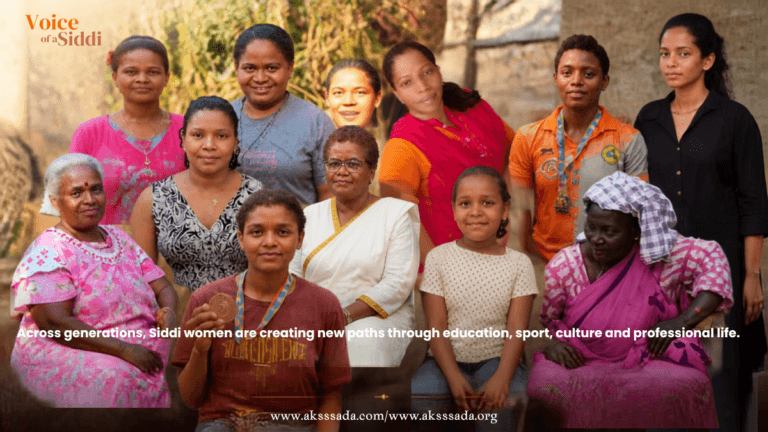
Across Uttara Kannada and other parts of Karnataka, Siddi women are entering fields that were once difficult to access. They are pursuing education, competing in sports, building professional careers, working in the arts, supporting other women and contributing to the preservation and visibility of Siddi culture.
Many of these achievements have happened quietly. There are women whose names may not regularly appear in newspapers or on large stages, yet their lives represent determination, courage, perseverance and change. Their experiences remind us that progress does not always begin with a major institution or a famous person. Sometimes, it begins with one woman choosing to continue despite the obstacles in front of her.
For a young Siddi girl, seeing a woman from her own community become an athlete, artist, researcher, professional or community worker can create a powerful sense of possibility.
If she can do it, perhaps I can too.”
That is why representation matters.
Every woman who enters a new field can help create a pathway for someone else. One woman completing higher education can inspire another girl to continue her studies. One woman entering a profession can show another young woman that a career she once thought was beyond her reach may actually be possible. One artist carrying Siddi culture beyond her village can demonstrate to the next generation that their heritage has a place on wider stages.
These achievements are more than individual success stories. They are part of a larger story of a community that is changing, growing and creating new possibilities while remaining connected to its identity.
As someone from the Siddi community myself, I believe these stories deserve to be documented, recognised and shared. They give visibility to women whose contributions may otherwise remain unseen, while offering younger generations examples of what determination and opportunity can make possible.
In our earlier stories about Siddi life, culture and community, we have explored different aspects of our heritage and identity. This article builds on that conversation by focusing on the women whose lives are helping shape the community’s present and future.
The women featured in this story come from different backgrounds and have followed different paths. Their achievements may be in education, sport, professional life, art, research or community work. Their journeys are different, but they share something important: they have refused to let circumstances define the limits of their dreams.
And that is why their journeys deserve to be remembered.
Because when one siddi woman steps forward, she may make it easier for another to follow.
Kamala Siddi — A Pioneer of Siddi Athletics
Kamala (Babu/Mingel) Siddi, from Chikuti village in Yellapur, is one of the pioneering names in Siddi athletics.
Born to Laxmi Siddi and Babu Siddi, Kamala was their only child. She grew up in a humble farming family in a remote forest area, where opportunities for education, sport and professional development were rare and limited. Her athletic talent was recognised through the Government of India’s Special Area Games programme, where she received specialised training. She went on to compete in pentathlon, heptathlon and hurdles, establishing herself as a talented athlete.
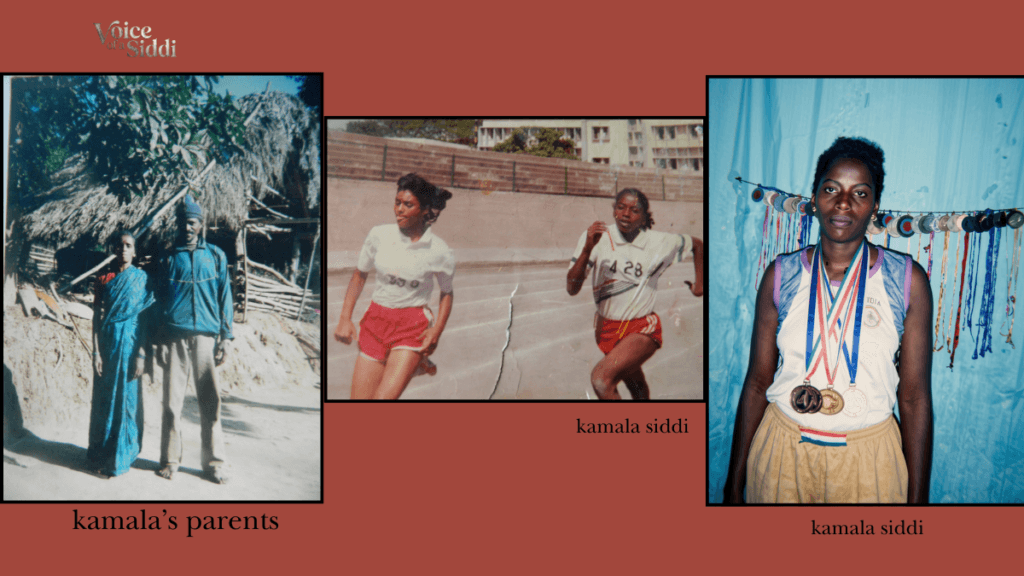
In 1991, Kamala won gold in the long jump at the Inter-Zonal Junior Athletics Championship.Her achievements reached the international level in 1993, when she won a bronze medal in the 100-metre hurdles at the South Asian Games in Dhaka. In the same year, she won three gold medals at the World Police & Fire Games.
From a remote Siddi village to international sporting arenas, Kamala’s journey represents talent, determination and opportunity. She showed that a young woman from a farming family could compete on major platforms and carry the name of the Siddi community beyond Karnataka.
Today, Kamala works with the Central Railway in Hubballi, continuing her professional journey beyond athletics.
Her story is more than a collection of medals. It is a reminder to young Siddi girls that where you come from does not have to determine how far you can go.
Kamala Siddi deserves to be remembered as one of the women who helped open the path for the generations of Siddi athletes who followed.
Girija and Geeta Siddi — Taking Siddi Culture Beyond the Village
When we speak about the achievements of Siddi women, we often think of education, employment, sports or social work. But culture, art and the preservation of community identity are equally important achievements.
The story of Girija Siddi and Geeta Siddi, two sisters from Devarkalhali village in Yellapur, is a beautiful example of how Siddi women have carried their culture beyond the boundaries of their village.
Girija and Geeta are two of three siblings — one brother and two sisters. Their father was himself an artist, and his encouragement played an important role in helping his children discover and develop their talents.
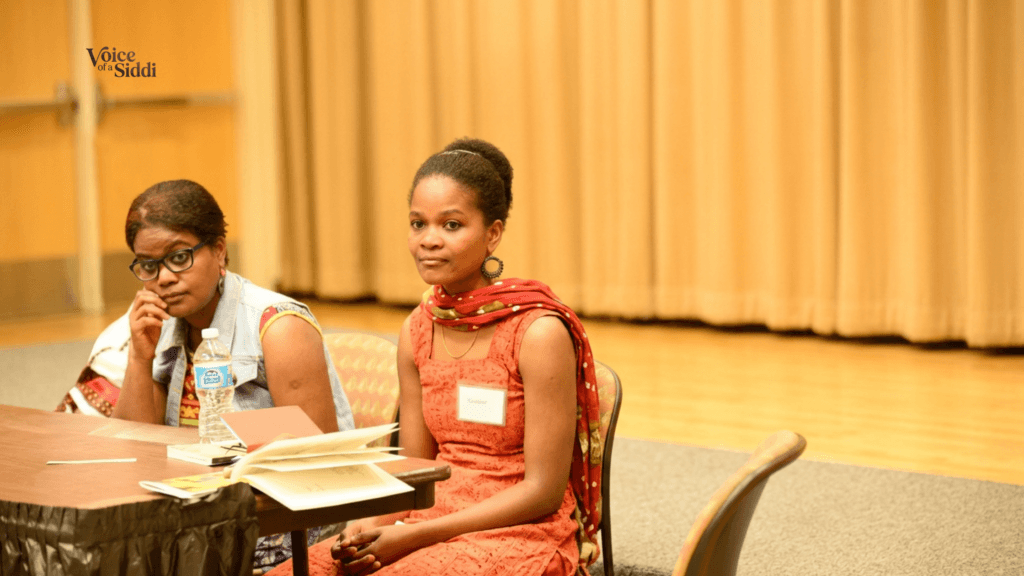
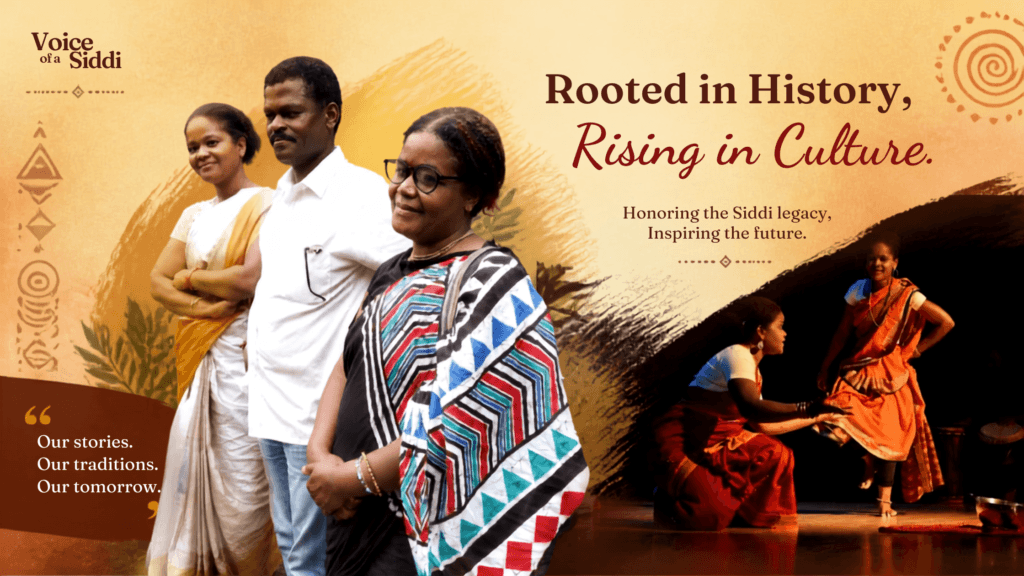
Growing up in a Siddi village surrounded by music, traditions, stories and community celebrations, the sisters developed a strong connection with their cultural roots. Their father’s support encouraged them to see art not simply as a part of village life, but as something they could pursue professionally.
Pioneers in Theatre
Both sisters went on to study theatre and became the first Siddi women to graduate in Theatre.This was more than an educational achievement. It opened a new path for Siddi women in the performing arts and demonstrated that Siddi stories and experiences could find a place on formal theatre platforms.
Girija continued her artistic journey into Hindustani classical music, combining her interest in wider Indian musical traditions with the cultural identity she grew up with. Geeta continued her work in theatre and performing arts and also became involved in research related to Siddi arts and culture. Her work is particularly meaningful because documentation and research can help preserve songs, stories, traditions and memories that have traditionally been passed from one generation to another through oral traditions.
From Devarkalhali to the United States
A significant moment in their journey came in 2016, when Girija and Geeta participated as international artists in the “Telling Our Stories of Home” festival in the United States. For two Siddi women who grew up in Devarkalhali village, reaching an international cultural platform was a remarkable achievement. More importantly, they carried with them the stories and cultural identity of the Siddi community.
Their journey shows that Siddi culture does not have to remain confined to the villages where it originated. It can be studied, performed, documented and shared with audiences around the world.
Girija and Geeta have demonstrated that a Siddi woman can pursue higher education in the arts, become a theatre artist, study classical music, undertake cultural research and represent her community internationally.Their story is ultimately about talent, family encouragement, education and cultural pride.They remind younger generations that moving forward does not mean leaving one’s roots behind. You can carry your culture with you wherever you go — and in doing so, help carry it into the future.
Siddi Women and the Power of Education
Education has the power to change not only an individual’s life, but also an entire family and, over time, a community.
For Siddi women, education can open doors to employment, financial independence, confidence, leadership and greater participation in society. Today, more Siddi girls and women are pursuing higher education, showing that the aspirations of the community are growing.
There are several Siddi women whose educational achievements deserve recognition.
Racheal Birji has completed her LLB, entering the field of law and demonstrating the expanding range of professional opportunities being pursued by Siddi women.Three sisters — Sheela Pascal Gabberkar, Reshma Pascal Gabberkar and Tina Pascal Gabberkar — have completed their M.A. and B.Ed. Their achievements reflect the importance of perseverance and family support in helping young women continue their education.
Among them, Reshma Pascal Gabberkar has achieved another significant milestone. She is a gold medallist in her M.A. and is currently pursuing her PhD.
These achievements are important because they show Siddi women moving into fields that require years of higher education and specialised study.
”
Education Opens New Doors
For many families, encouraging a daughter to continue her education represents an important change.A young woman who completes school, attends college, earns a degree or pursues postgraduate studies can become a role model for younger girls in her family and community. Her achievement can encourage other parents to support their daughters and help young Siddi girls see higher education as a realistic possibility.
Education is not simply about earning a certificate. It can lead to employment, professional careers, financial independence and greater confidence in making one’s own decisions.
For Siddi women, the growing pursuit of education is therefore more than a collection of individual achievements. It is part of a larger change in the community.Today, Siddi girls are studying for undergraduate and postgraduate degrees, professional qualifications and research programmes. Each achievement expands the idea of what is possible for the next generation.
When one Siddi woman moves forward through education, she can help create a path for many others to follow.
Vimala Hanchinmani — Education With a Purpose
Among the earlier generation of educated Siddi women, Vimala Hanchinmani holds a very special place. One of six siblings, she was the only one in her family to complete graduation and, during those years, was among the very few — and, to the best of our knowledge, the only Siddi woman in her community at that time — to achieve that milestone.
Her journey was not easy. She was determined to study, even though she faced discrimination in the classroom. She was the only Siddi girl in her class, and some classmates made fun of her because of her hair and skin colour. Instead of allowing those experiences to stop her, Vimala continued her education and completed her graduation in the early 1990s.
Her achievement was more than a personal milestone. At a time when very few Siddi women had access to higher education, Vimala quietly broke a barrier and showed that a Siddi girl could enter a classroom, face prejudice, continue her studies and graduate.
Today, Vimala works as a social worker and helps women learn practical skills such as stitching, encouraging them to become more confident and independent. Her journey shows that education is not only about earning a degree — it can give a person the strength to overcome barriers and the opportunity to help others.
Vimala’s story is not just a story of education. It is a story of courage, perseverance and being a pathbreaker for the Siddi women who came after her.
My Own Journey as a Siddi Woman
When I speak about Siddi women breaking barriers, I also find myself reflecting on my own journey.
My journey is different from the women whose stories I have shared, but it is also part of the larger story of Siddi women who have created new possibilities for themselves and for the generations that followed.
A Father Who Believed in Education My journey began with education, and much of that opportunity came from my father.
My father was a government employee and the first graduate from our Siddi community.At a time when higher education was not easily accessible to many members of our community, his achievement was significant.
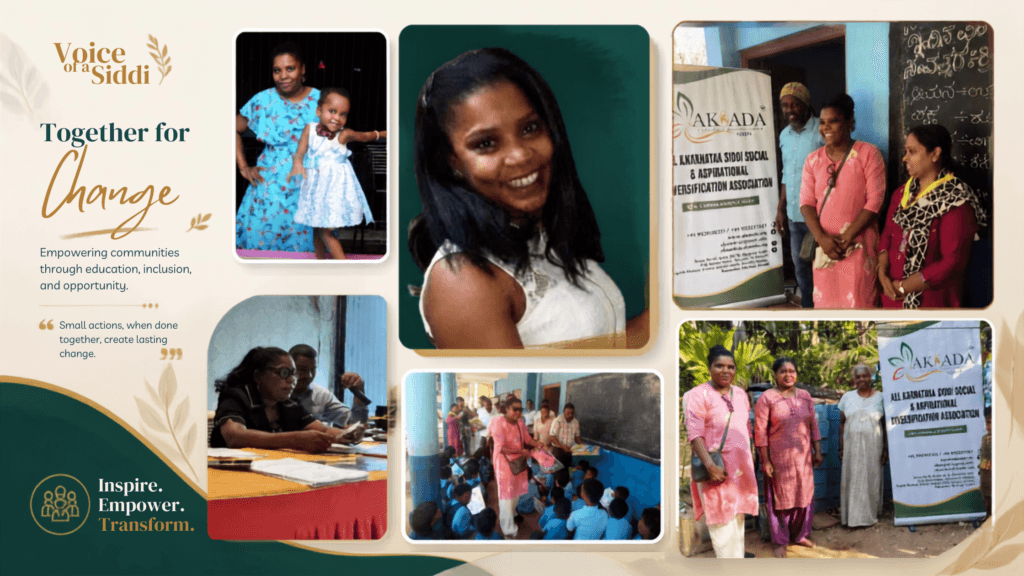
Because he understood the value of education, he strongly believed that girls should also have the opportunity to study and build their own futures. In the early 1980s, I was among three girls from our community who had the opportunity to attend an English-medium school.
The other two girls were the daughters of my father’s (siddi )friend. They also began their education in an English-medium school, but unfortunately, their schooling did not continue beyond the 5th standard.
My education continued.Looking back today, I realise how important my father’s belief in education was. He had already broken a barrier by becoming the first graduate from our Siddi community, and he wanted the next generation to have opportunities that had not been easily available to his generation.
His belief became one of the foundations of my own journey.
From Education to Civil Engineering
I continued my education and eventually completed my Diploma in Civil Engineering in 2002.At the time, I expected to build a career in the technical field for which I had trained.After getting married in 2003, I started working in 2004 and began looking for employment related to my qualification.But finding a job was not easy.
During some interviews, I experienced something particularly painful as a Siddi woman. Because of my African features, there were people who questioned whether I was Indian.In one interview, I was told:“We cannot give the job to Africans.”Those words were deeply hurtful.
I had studied, completed my diploma and was simply looking for an opportunity to work. Yet my appearance seemed to matter more to that person than my education or qualification.
It was a painful experience, but it also became part of the journey that shaped me. An Unexpected Career Sometimes, when one door closes, another opens in a completely unexpected direction.
At that time, my husband was doing part-time modelling, and I began helping him with his work.
Mumbai’s advertising industry was producing television commercials for markets including Kenya, Uganda, Tanzania and South Africa. There was a requirement for models with African features for some of these projects.
This eventually opened an unexpected opportunity for me. In 2004, I began working as a model coordinator, sourcing and coordinating models for advertising projects. It was very different from the career I had imagined when I studied Civil Engineering.
But I learned the work, developed professional relationships and built experience in the field.What began as an unexpected opportunity gradually became a profession.More than two decades later, I continue to be connected with this profession.
Giving Back to the Community
Today, when I look back at my journey, I feel grateful for how far life has taken me.I have built my career, created my own identity and, most importantly, found a purpose that goes beyond my professional life.
Today, one of the things closest to my heart is giving back to the Siddi community.I want the opportunities that I received to reach others as well.
I want young Siddi girls and boys to believe that they can dream, study, build careers and create lives beyond the limitations that may have surrounded previous generations.For me, giving back is not only about helping someone today. It is about helping create opportunities that can continue into the future.
The Next GenerationMy journey has also given me the greatest responsibility and joy of all — being a mother.My son is completing his Computer Engineering, and seeing him build his own future makes me proud. His journey represents another generation moving forward through education and opportunity.
I also have a daughter who is, in many ways, my reflection.Through her, I see the hopes, dreams and possibilities of the next generation of Siddi girls.My greatest wish for her is that she will be blessed with happiness, confidence, strength and the freedom to choose her own path.
I want her to grow up knowing her roots, respecting where she comes from and never allowing anyone to tell her that her background limits what she can become.As a mother, I hope that my children will go further than I did.
And as a Siddi woman, I hope that the generation after mine will have even more opportunities than we had.
Our Stories, Our Future
The women whose stories I have shared have each created their own paths — through sport, education, theatre, music, research, professional careers and service.
Their journeys are different, but together they tell one powerful story:
Siddi women are moving forward. These women remind us that achievement does not always begin with privilege or perfect circumstances. Sometimes it begins with a young girl who loves school. Sometimes with an athlete who discovers her talent in a remote village. Sometimes, two sisters decide to study theatre. Sometimes, with a father who believes his daughter deserves an education. And sometimes with a woman who faces rejection but chooses to keep moving forward.
I believe these stories deserve to be documented because they belong to all of us. They belong to the women who came before us. They belong to the women who are creating opportunities today. And they belong to the young Siddi girls who will carry this story into the future.
Our achievements should not end with us. They should become the foundation on which the next generation can build. That is the story I want to tell — not a story of perfection, but a story of courage, opportunity, perseverance and hope.
The story of Siddi women who are finding their voices, breaking barriers and creating new paths.
And I hope that one day, the young girls reading these stories will not ask whether they can achieve something.
They will simply believe: “If she could do it, so can I.