Siddi Culture in Karnataka: Heritage, Identity and Everyday Life
What Is Siddi Culture in Karnataka?
Siddi culture in Karnataka is the living heritage of an Indian community of African ancestry whose history, identity, and everyday life have evolved across the subcontinent over several centuries.
In Karnataka, Siddi communities are primarily rooted in the lush regions of Uttara Kannada, where cultural life has flourished through the harmonious union of African lineage, Indian geography, regional languages, rural occupations, distinct faiths, and collective community memories.
Understanding Siddi culture requires looking far beyond a single performance, dance, or folklore narrative. True culture breathes quietly in family recollections, culinary practices, local dialects, kinship bonds, shared agricultural labour, spiritual observances, and the lived understanding of identity.
For the Siddi people of Karnataka, heritage is not an artefact preserved in a museum glass case; it is an active, evolving reality carried forward through everyday existence.
African Roots and an Indian Home
The presence of the Siddis in India is intertwined with historical movements across the Indian Ocean and the Portuguese maritime trade over several centuries.
Archival records and historical research document how African individuals transported to western coastal India gradually established enduring settlements across the Western Ghats of Karnataka.
Modern biological and anthropological research reinforces this history.
Genetic studies of Siddi populations in Karnataka reveal clear African ancestry, tracing several paternal lineages directly to sub-Saharan African populations, particularly Bantu-speaking groups, alongside indigenous Indian genetic markers.
Yet ancestry is only one chapter of identity. Over generations, Siddi families built deep, permanent homes in India, actively participating in rural village life and shaping their existence within Karnataka’s wider cultural framework.
Siddi identity cannot be reduced solely to historical African origins, nor can it be simplified into a generic regional description.
It is a distinct, living Indian identity shaped by African roots, deep localized belonging, and centuries of continuous adaptation.
Siddi Communities in Uttara Kannada
The geographic heart of Siddi heritage in Karnataka is the Uttara Kannada district.
The Government of India’s official Scheduled Tribe list specifically designates Siddi communities in Karnataka across the Uttara Kannada, Belagavi, and Dharwad districts.
Furthermore, the Uttara Kannada district administration recognizes Siddi settlements as integral to the local fabric, particularly across taluks such as Haliyal, Yellapur, and Ankola, officially acknowledging their performing arts within the traditional folk expressions of the region.
This environmental landscape is central to their culture. The towering forests, fertile valleys, farming traditions, and village social structures of the Western Ghats have provided the sanctuary and resources through which Siddi families have adapted and thrived over generations.
Siddi culture in Karnataka Is More Than a Performance
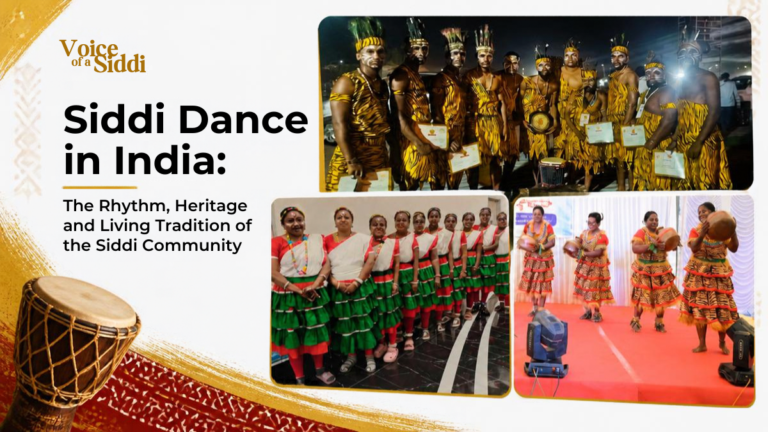
Popular representations of Siddi culture in Karnataka frequently reduce the community to energetic dance and drumming. While traditional performing arts such as the Damami dance and street theatre are profoundly significant expressions of collective memory, they do not encompass the entirety of community life.
Performances serve not merely as entertainment for outsiders, but as historical vessels combining African rhythmic sensibilities with Indian folk traditions, providing a space for social commentary, identity assertion, and community bonding.
Siddi culture in Karnataka Music, Dance and Storytelling
Music and dance act as historical archives where written texts were historically denied. Through rhythmic drumming and communal singing, Siddi performers articulate joy, sorrow, forest relations, and community struggles, transferring knowledge organically across generations.
Food and Everyday Knowledge
Siddi culture in Karnataka preservation is equally alive in the kitchen. Traditional recipes and forest foraging practices are handed down through direct observation—children watching mothers and grandmothers work with seasonal greens, bamboo shoots, wild tubers, and regional spices.
Documenting traditional culinary habits preserves invaluable indigenous knowledge that risks being lost in an era of rapid commercialization.
Siddi Identity Has Continued to Evolve
Siddi culture in Karnataka is never static. Siddi families navigate ongoing shifts in formal education, modern employment, diverse religious affiliations (including Hindu, Muslim, and Christian faiths), technological integration, and civic engagement.
Research and lived experience both demonstrate that community identity continues to adapt dynamically within contemporary Indian democracy.
Preserving cultural heritage does not mean freezing a people in the past or resisting progress; it means maintaining pride in roots and oral history while exercising the agency to define one’s own future.
A young Siddi university student navigating digital life is just as authentic an expression of the culture as an elder working in an areca nut plantation. Both belong to the continuous story.
What Can We Learn From Siddi Cultural Heritage?
Documenting community heritage responsibly requires practical, ethical commitments:
1. Record Family Stories
Elders hold living history that rarely appears in history textbooks. Documenting family lineages, migration memories, forest traditions, recipes, and dialect nuances safeguards vital cultural memory for future generations.
2. Document With Permission and Context
True Siddi culture in Karnataka preservation centres the community. Photographs, interviews, audio recordings, and family lore must be collected with informed consent, giving community members full ownership and voice over their narratives.
3. Avoid Treating One Experience as Universal
There is no single, homogenous Siddi experience. Variations in religion, geographic location, economic occupation, and lineage mean that cultural expressions differ from village to village.
Responsible documentation honors these nuances with precision rather than broad generalizations.
4. Let Younger Generations Lead
Youth empowerment is the ultimate guardian of heritage. Encouraging young community members to record audio, film short documentaries, archive documents, and manage digital platforms transforms heritage preservation into an active livelihood and community skill.
Frequently Asked Questions About Siddi Culture
Are Siddis African or Indian?
Siddis are citizens of India with African ancestry. Historical records and modern genetic research document African roots alongside Indian heritage. Having lived in India for centuries, Siddis are an integral part of the country’s diverse social tapestry.
Where do Siddis live in Karnataka?
The highest concentration of Siddi communities is in the Uttara Kannada district (particularly around Haliyal, Yellapur, and Ankola), with recognized populations also residing in the Belagavi and Dharwad districts under the Government of India’s Scheduled Tribe orders.
Is Siddi dance recognized as part of Karnataka's cultural heritage?
Yes. Traditional Siddi dance forms are officially recognized among the folk arts of Uttara Kannada by district authorities, and academic research highlights their unique synthesis of African rhythm and Indian folk storytelling.
Is there a single, uniform Siddi culture?
No. Siddi culture varies naturally based on geography, religious practice (with families practicing Hinduism, Islam, or Christianity), family history, and regional dialects across North Karnataka.
Final Thought: Heritage Lives When People Carry It Forward
Siddi heritage in Karnataka is an enduring testament to resilience, belonging, and cultural adaptation.
It is celebrated on festival grounds, but it survives through quiet dignity: an elder recounting an oral history, a family sharing a seasonal forest meal, a handmade quilt stitched with care, or a child proudly reading a book about their ancestors.
Preserving culture is not merely about looking back at history—it is about providing the tools, pride, and platforms for the next generation to carry that history forward.
A Small Step You Can Take
Ask an elder in your family or community this question:
“What is one tradition or story from your youth that you hope our grandchildren will never forget?”
Write down their words. That single record is where your living archive begins.